The Anatomy of Trend Continuation: How to Ride the Middle of Big Moves

Most traders dream of catching tops and bottoms, but professionals know the real money lies in the middle of the move — the clean stretch where price trends smoothly with minimal noise.
That center portion of the trend is where conviction is highest, risk is manageable, and continuation patterns reveal themselves clearly.

But to ride this powerful middle phase, you must understand the anatomy of trend continuation — what it looks like, how it behaves, and why it forms. This article will teach you to recognize continuation with clarity so you’re not entering too late or exiting too early.

What Is Trend Continuation?

Trend continuation is the phase where price pauses, refreshes, and resumes in the same direction.
It’s not a reversal, not a top, and not exhaustion — but the healthy breathing pattern of a trending market. Continuation phases show up as:
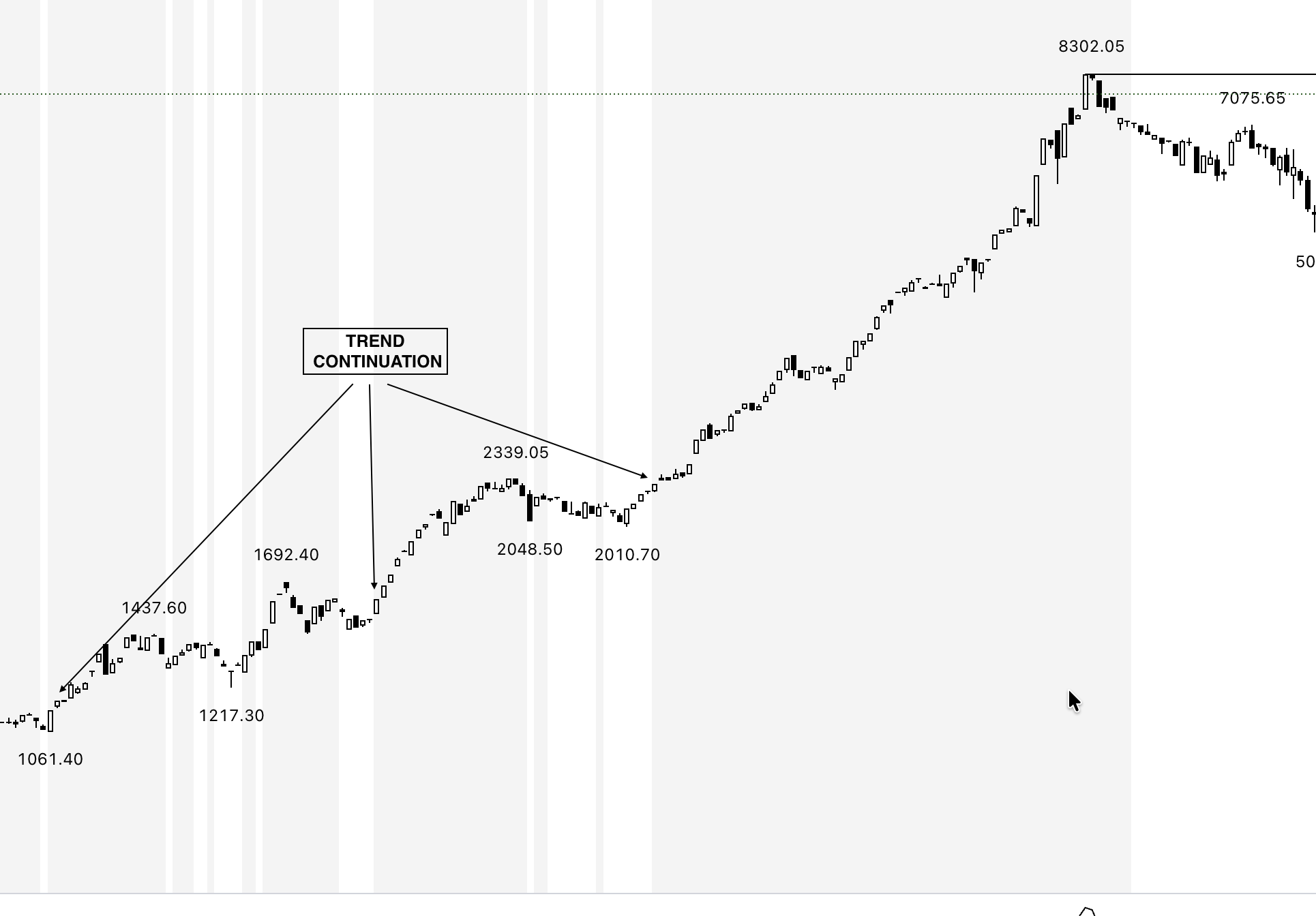
  • Pullbacks
  • Consolidations
  • Inside bars
  • Retests
  • Tight ranges
  • Shallow dips
These are not weakness — they are strength disguised as rest.

Why Trend Continuation Is the Safest Part of the Move

  1. Trend confirmation is already present
    You’re not guessing direction — the trend is visible and validated.
  2. Structure provides clarity
    Higher highs + higher lows in uptrends.
    Lower highs + lower lows in downtrends.
  3. Entry points are logical and low-risk
    Pullbacks, retests, and tight consolidations give precise stop placement.
  4. Momentum supports your trade
    You have the wind at your back, not against you.
  5. Continuation moves often travel farther than expected
    Once refreshed, trends expand again — often sharply.
This is why the middle phase is where institutions scale heavily.

The Market Psychology Behind Continuation

Continuation phases reflect balanced behavior between buyers and sellers.
Here’s the sequence:

  • Early buyers have profits and start booking.
  • Sellers attempt to push price down.
  • Buyers defend key levels.
  • Liquidity is created for institutions to accumulate more.
  • Once supply dries up, price surges again.
This is the natural cycle of expansion → contraction → expansion.
A trend doesn’t move in straight lines — it breathes.
Understanding these breaths is the essence of trend trading.

How True Continuation Differs from Reversal

Many traders mistake pullbacks for reversals.
Here’s how to avoid that trap:
1. Depth of Pullback
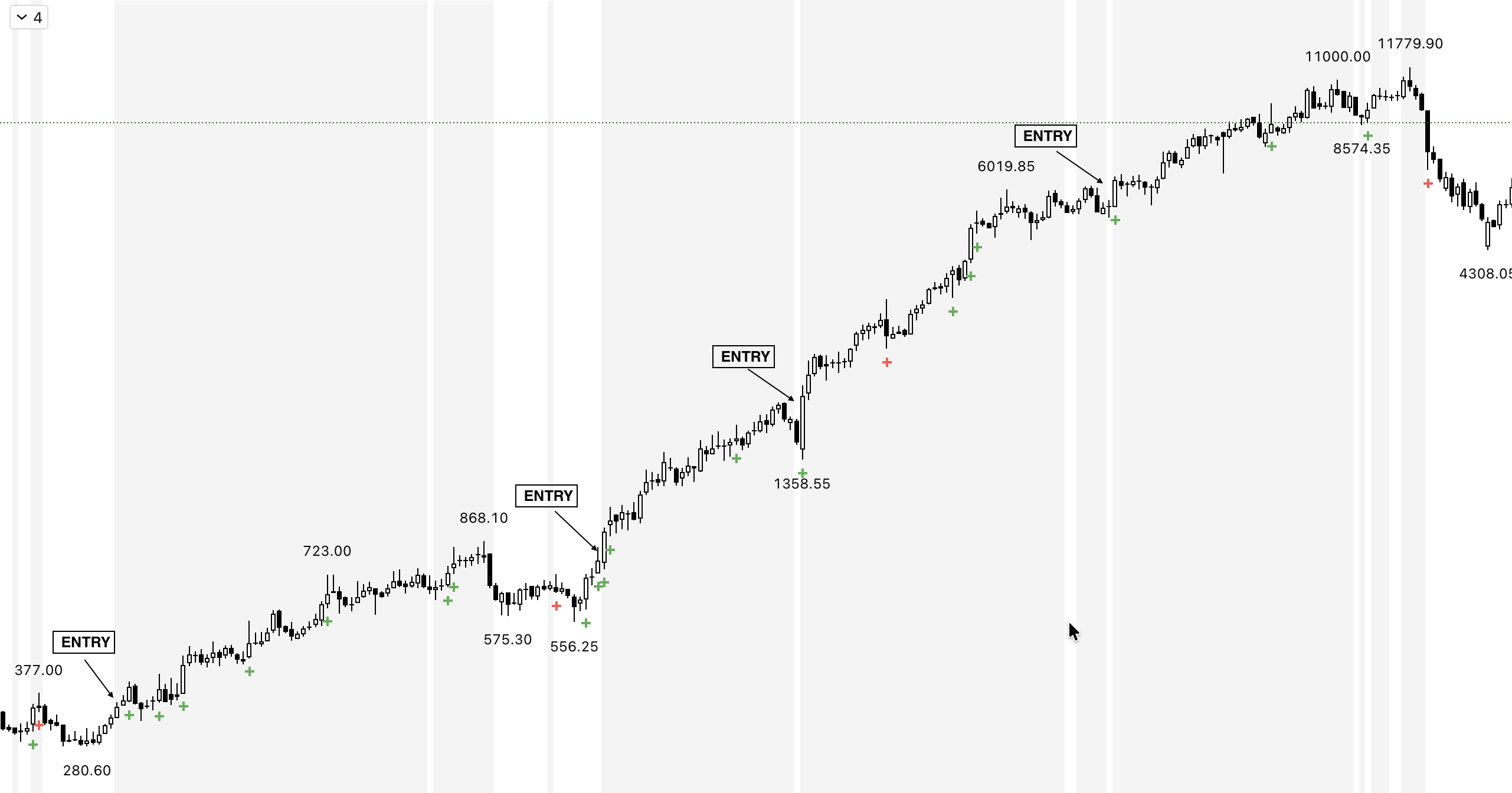
  • Continuation: Shallow, controlled dips that stay above key levels.
  • Reversal: Deep, impulsive drops breaking structure.
2. Candle Quality
  • Continuation: Small-bodied candles, wicks showing absorption.
  • Reversal: Wide-range candles showing aggression.
3. Volume Behavior
  • Continuation: Volume contracts during pullback.
  • Reversal: Volume expands against the trend.
4. Time Duration
  • Continuation: Quick pauses.
  • Reversal: Prolonged stalling or breaking key swing levels.
Continuation moves are quiet, clean, disciplined.
Reversals are loud, chaotic, and emotional.

Price Action Patterns That Signal Continuation

  1. Bull Flags / Bear Flags Tight corrective channels that break back into trend direction.
  2. Inside Bar Clusters Compression zones signaling energy buildup.
  3. Retests After Breakouts Old resistance becomes support; old support becomes resistance.
  4. Higher Lows / Lower Highs Structural confirmation of trend health.
  5. Shallow Fibonacci Retracements 38.2% or less is typically strong continuation behavior.
  6. Narrow Range Consolidation The tightest ranges often precede the strongest continuation moves.

How to Trade Continuation with Precision

  1. Identify the Trend First Never trade continuation in a messy or range-bound chart.
  2. Mark Key Swing Levels Swing highs/lows act as anchor points for continuation entries.
  3. Wait for Compression Tight ranges show that the trend is ready for the next leg.
  4. Enter on Breakouts or Retests Two high-probability entries:
    -Breakout of consolidation
    -Retest after breakout
  5. Place Stops Logically Below swing lows in uptrends, above swing highs in downtrends.
  6. Trail Your Stops Let the market guide you — adjust only as structure forms.

The Role of Patience in Continuation

The trend may be strong, but continuation setups are not frequent. They are selective — and waiting for them separates professionals from impulsive traders. Impatient traders:

  • Enter too early
  • Chase candles
  • Misread noise as opportunity
Disciplined traders:
  • Let the trend mature
  • Wait for proper structure
  • Enter only when context is aligned
The trend gives clues — but only to those who wait for clarity.

Conclusion

Trend continuation is the heart of profitable trading. It’s where the market offers the best blend of momentum, structure, and risk control. When you learn to recognize continuation patterns — the pauses, the consolidations, the retests — you begin trading with the market, not against it.

Real growth happens not at the extremes but within the calm, steady middle of a trend. Master that, and you stop chasing markets — you start flowing with them.

X

By Sunil Sethi
Trading markets since 2016 | Swing & Positional trader | Price Action | Reversals
Building clarity in the chaos of charts — blending tech leadership with market mastery.

VIP - VERY IMPORTANT PERSON
VIV - VERY
IMPORTANT VOLUME
⇢ BE A VIP WITH VIV ⇠

Learn. Apply. Trade Smarter with VIV →